A wooden automaton is a small machine that makes a wooden figure move. In the dictionary sense it is a self-operating machine that follows a fixed sequence of motions, and the word has long been tied to moving figures of people and animals. The desk-sized kind needs only a handful of parts: a source of turning motion, and some wooden and metal pieces that spread that one turn into a whale rolling, a manta gliding or a dragon folding its wings.
This guide explains the parts you will meet most often, which are cams, cranks, wires, rods, pins and magnets. Each one is shown with a real piece from the MoveArtly collection, so you can see the idea at work and judge how much of the machinery you want on display.
The one idea behind every automaton
Almost every wooden automaton does the same job: it takes one steady turn and spreads it into several different movements. A motor or a hand crank supplies the turn. Cams, arms, wires and pins decide what each part of the animal does with it. The craft is in the timing, because a figure only looks alive when its parts do not all move at the same moment.
Cams: how a turn becomes up and down
A cam is a rotating piece that pushes on a lever or rod as it turns. In engineering terms it converts rotary motion into reciprocating, up-and-down motion, and a car's camshaft is the textbook example. Give a shaft several cams set at different angles and a single turn lifts several parts, one after another.
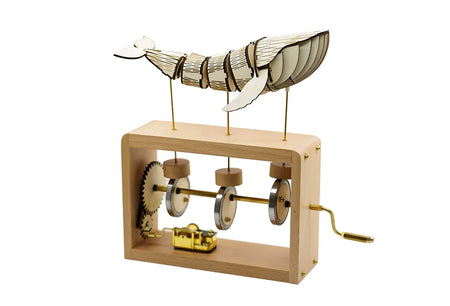
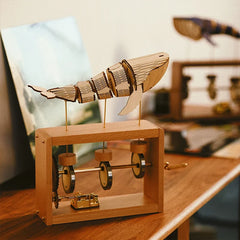
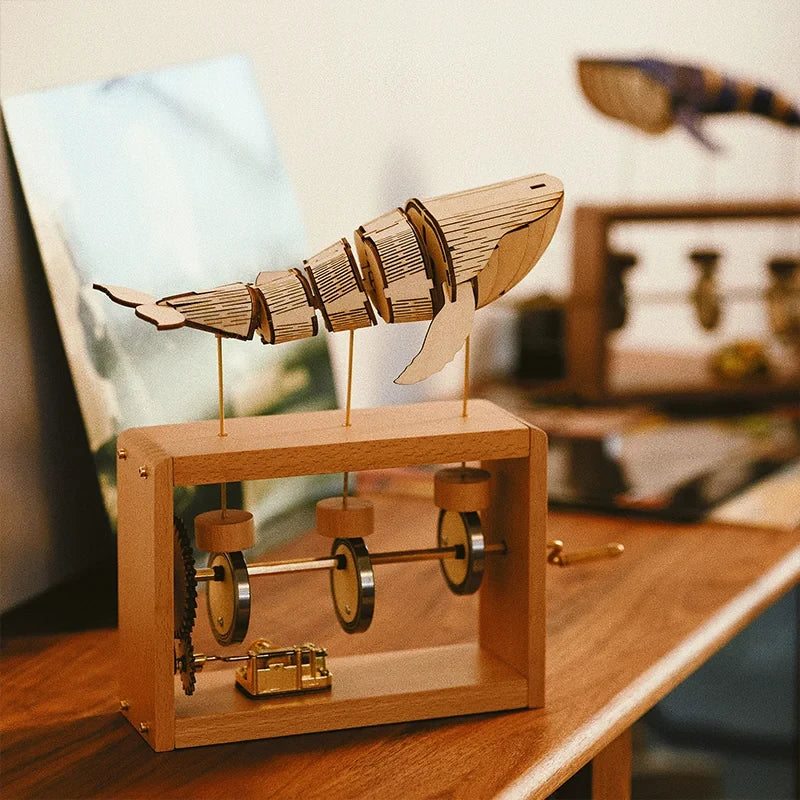
Tidehymn shows the idea in the open. A crank turns a shaft with three cams, and each cam lifts one brass rod a moment after the last, so the jointed whale rolls from head to tail. The frame is open, so you can watch the gears, the cams and the music box comb at work.
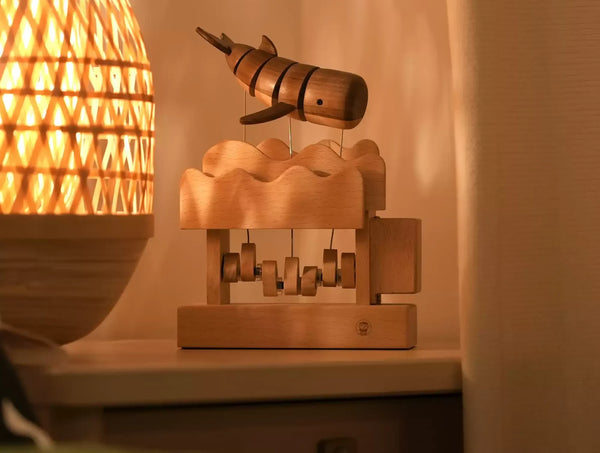
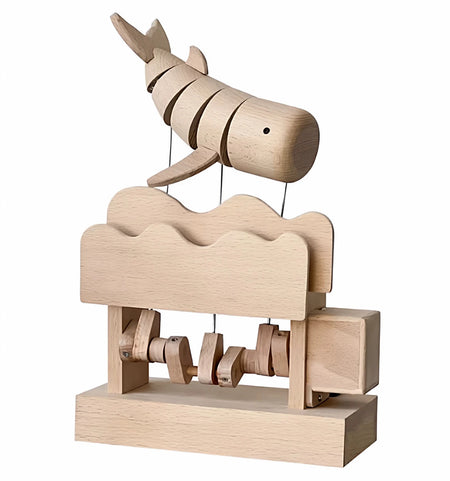
Wavecrest hides the same idea. A small motor turns a shaft of cams inside a pale wood box, each cam lifts a wire in turn, and the striped whale rolls over a wave-shaped top that conceals the wires as they rise.
Cranks and motors: where the turn comes from
A crank is an arm fixed at a right angle to a rotating shaft. A hand crank lets a person turn that shaft directly, and a motor does the same job without a hand.
Tidehymn is the hand-cranked example. It needs no batteries: you turn the crank by hand, and that one turn both moves the whale and plays the music.
Most other pieces use a small motor. In Pipwing the motor sits in the small dark wood box and moves a brass rod that drives the two wings, so they beat up and down; a touch on the brass button starts it and steps through three speeds. Tidewing uses one small motor to turn a single shaft at a steady speed, and wooden arms carry that turn out to the wings. How each piece is powered is covered in our setup and care guide.
Wires and rods: how the animal hangs in the air
Many pieces hang their animal from thin wires or a slim rod above a box. In Polar Lance three steel wires rise through slots in the wooden box and move up and down out of step. The narwhal's body is made in sections, and each wire lifts a different one, so the jointed body bends from head to tail as if breathing at the surface, instead of moving as one stiff piece.
In the flying pieces a rod does the holding and the wires do the moving. A slim metal rod holds the pig of Skyhog in the air while thin wires run from the top of the box up to its wings. In Lakesong a brass rod holds the swan, a fine wire runs up into its body, and nothing touches the wings directly: one small pull from below and both rise together.
Why a small delay makes it look alive
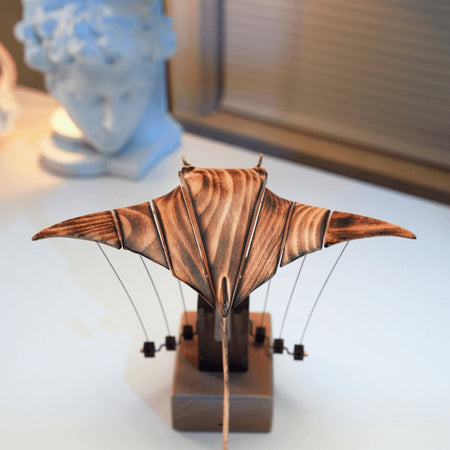
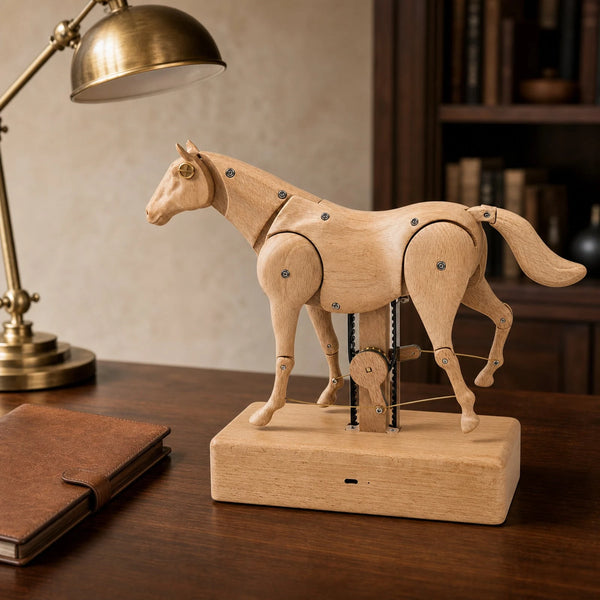
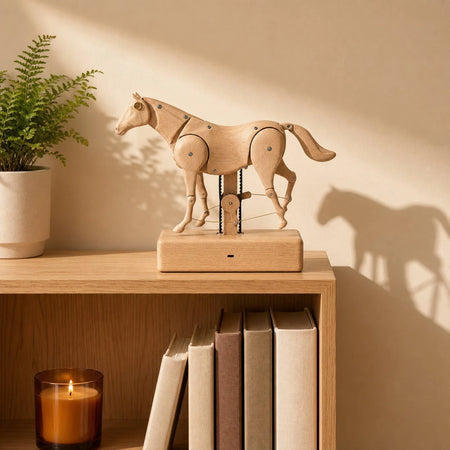
Watch a real manta, whale or horse and nothing moves in perfect unison. The better wooden pieces borrow that. In Tidewing each wooden arm takes up the turn a moment after the one before it, so a motor running at one steady speed becomes a slow, uneven glide. Canterwood uses the same principle for walking: thin cords run from a wooden wheel out to the legs, and each cord pulls a moment after the one before, which gives a canter rhythm instead of all four legs at once.
Joints, links and pins
Legs and flippers need joints. Farstride builds each leg as a chain of small wooden links pinned together. A mechanism in the base moves two slim rods, and the links pass the motion down each leg, so the gallop rolls from shoulder to hoof.
In Canterwood every leg joint is held by a small metal pin you can see from the outside, and a toothed belt runs up the post to a wooden wheel under the body. In Longshore each flipper is pinned at the shoulder, so it sweeps forward and back like a rowing stroke instead of flapping up and down, while the shell stays almost still.
No wires at all: magnets
Not every piece has visible parts. In the Levitating edition of Floatfin, magnets in the pale wood base and in the carved dark wood whale push against each other, and the base keeps that push steady so the whale stays up in the air. That edition's base plugs in. The Standing edition needs no power: the same whale sits on a slim brass rod above a dark wood stand.
Open or hidden: what to look for when you choose
Some people want to see the machinery, others only want the motion. Tidewing comes both ways. On the External gear base the wheel sits outside, so you can watch it turn; on the Internal gear base it is the same motion with the wheel tucked inside.
Tidehymn is open by design, while Wavecrest keeps its cams under a wave-shaped top. Neither is better. It comes down to whether you want a machine to study or a sculpture to watch.
A short glossary
- Cam: a rotating piece that pushes on a lever or rod and turns rotation into up-and-down motion.
- Crank: an arm fixed at a right angle to a shaft, turned by hand or by a motor.
- Shaft: the rod that carries the turn from the crank or motor to the cams or arms.
- Rod and wire: the parts that carry the motion up to the animal, or hold it in the air.
- Pin: the small metal peg that lets two wooden parts swing against each other, as in a leg joint.
To see these ideas in motion, browse the full MoveArtly collection, or start with a theme: the ocean pieces, the flying pieces, or the field pieces for the two horses. Our guides to ocean pieces and flying pieces go piece by piece.